Wallabag has been the trusty self-hosted read-it-later app since 2013, and it still wins on stability and ecosystem. The problem in 2026 is the same as in 2020: the UI looks like a tool that has been around since 2013, the AI tagging never landed, and setup is fussier than the newer competition. After Omnivore shut down and Pocket announced its July 2025 sunset, a wave of new self-hosted options have surged ahead. These Wallabag alternatives cover what is actually worth migrating to.
This piece focuses on desktop self-hosting on Windows, macOS, and Linux (most of these run in Docker). We weighed setup friction, AI features, mobile apps, browser extensions, and how each handles the read-archive-export loop. Whether we want a feature-rich modern stack or a minimalist tool we forget is running, one of these will land.
Quick comparison
| App | Best for | Free | AI tagging | Mobile apps |
|---|---|---|---|---|
| Karakeep | Modern self-hosted with AI | Yes (FOSS) | Yes (Ollama) | iOS + Android |
| Readeck | Clean read-focused experience | Yes (FOSS) | No | Web (PWA) |
| Linkwarden | Bookmark manager + read-later | Yes (FOSS) | Yes (optional) | iOS + Android |
| Shiori | Minimalist Pocket-style clone | Yes (FOSS) | No | Web (PWA) |
| Linkding | Tag-centric bookmark archive | Yes (FOSS) | No | Web (PWA) |
| Readwise Reader | Paid hosted with deep highlights | No (trial) | Yes | iOS + Android |
| Matter | Free hosted alternative to Wallabag | Yes | Yes | iOS + Android |
Why people leave Wallabag
The interface feels frozen in time. Wallabag’s UI has not had a meaningful refresh in years. Multi-column reading, modern typography controls, and a polished tagging UX are all weaker than newer competition. After spending a year on Readeck or Karakeep, going back to Wallabag feels like stepping into 2018.
No native AI tagging. Karakeep does this out of the box — drop a link, an Ollama-hosted local LLM tags it and writes a one-paragraph summary. Wallabag has a third-party extension that does some of this, but it has not been promoted to a first-party feature.
Setup friction. Wallabag’s official Docker image needs a separate database container, a reverse proxy, and a fair amount of fiddling to make the Android app’s auto-sync work. Linkding, Shiori, and Linkwarden all spin up cleanly with single-container Docker Compose.
The first-party mobile app is showing its age. The Android client has been stable but slow to add features. Karakeep’s mobile app, by contrast, ships parity with the web in weeks.
Article extraction is hit-or-miss. Wallabag’s content extractor handles most articles, but JavaScript-heavy modern sites (Substack newsletters, Medium logged-in articles, certain news paywalls) often come back with stripped or missing content. Readeck and Karakeep use newer extractors that fail less often.
If any of that resonates, here are the Wallabag alternatives worth trying.
The 7 best Wallabag alternatives for desktop self-hosting
Karakeep — best modern self-hosted with AI
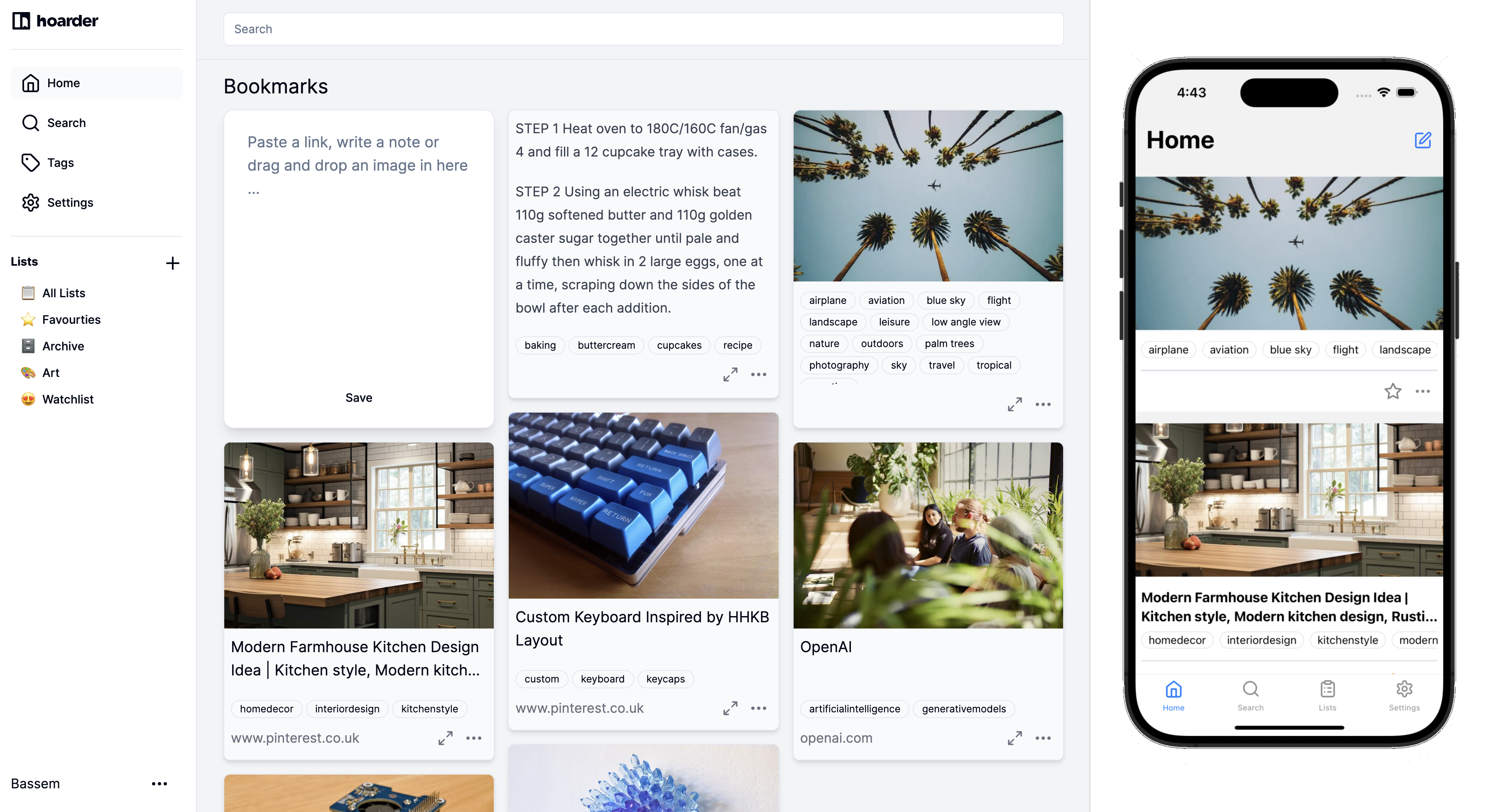
Karakeep (formerly Hoarder) is the breakout self-hosted read-later app of 2026. The single-container Docker setup spins up in under five minutes, and the Ollama integration tags and summarises articles using a local LLM — everything stays on our hardware. The web UI is the cleanest in this category, with infinite scroll, full-text search, and a proper distraction-free reader.
The mobile apps for iOS and Android sync reliably and include offline reading. The browser extensions for Chrome and Firefox capture pages cleanly, including paywalled content if we are already logged in.
Where it falls short: AI features need Ollama running somewhere (a local desktop, a Mac mini, or the same server with enough RAM for a small model). E-ink device support is weaker than Wallabag’s. The first major release happened recently, so some long-tail features are still missing.
Pricing:
- Free: full feature set
- Paid: optional Karakeep Cloud (not yet launched as of mid-2026)
- vs Wallabag: same cost (free), much faster setup
Download: karakeep.app (Docker on Windows, macOS, Linux)
Bottom line: Pick Karakeep if we want a modern self-hosted read-later with AI tagging. Skip it if we are an e-ink power user or our server cannot run an LLM.
Readeck — best clean read-focused experience
Readeck is the read-focused tool that picked up where Wallabag’s interface left off. The UI is opinionated and pleasant: a single-column reading layout, e-book export, in-app highlight, and a beautiful typography panel. It runs as a single Go binary, which means the install is downloading a file and running it — no Docker required.
The browser extensions and Android app are solid. The bookmarklet is the cleanest way to save articles on desktop without a browser extension.
Where it falls short: No AI features. No first-party iOS app yet (Wallabag has one). The tagging system is simpler than Karakeep’s. Less of an integration ecosystem than Wallabag’s old guard.
Pricing:
- Free: full feature set
- Paid: none
- vs Wallabag: simpler install, simpler app
Download: readeck.org (Windows, macOS, Linux binaries)
Bottom line: Pick Readeck if we want a clean reader and we are happy with manual tagging. Skip it if AI features or iOS apps are non-negotiable.
Linkwarden — best bookmark + read-later hybrid
Linkwarden treats links as first-class objects with archival, full-text search, optional AI tagging, and team-style collaboration features. It is more of a bookmark manager than a pure reader, but the saved-content view is good enough that most read-later use cases work fine. The Docker Compose stack is straightforward.
For users who care about archival as much as reading, Linkwarden’s option to snapshot the full HTML, PDF, and screenshot of every page is unmatched on this list.
Where it falls short: The reader view is functional but not as polished as Readeck or Karakeep. Full snapshotting costs disk space (1-3 MB per article). AI features are opt-in and require a separate provider key.
Pricing:
- Free: self-hosted, no caps
- Paid: hosted Linkwarden Cloud at $4/month
- vs Wallabag: similar setup difficulty, more features
Download: linkwarden.app (Docker on Windows, macOS, Linux)
Bottom line: Pick Linkwarden if we want bookmark management plus read-later in one tool. Skip it if reading polish matters most.
Shiori — best minimalist Pocket clone
Shiori describes itself as a “simple clone of Pocket,” and that is exactly what it is. The Go binary single-file install is the easiest setup on this list — download, run, done. The interface is minimal, the feature set is intentionally small, and the page archiver captures content locally without third-party services.
For users who just want a private Pocket-style archive without complexity, Shiori delivers in under ten minutes.
Where it falls short: No AI. No native mobile apps (the PWA works). Tagging is basic. UI is functional but unadorned.
Pricing:
- Free: full feature set
- Paid: none
- vs Wallabag: much simpler, fewer features
Download: github.com/go-shiori/shiori (Windows, macOS, Linux binaries)
Bottom line: Pick Shiori if minimalism and a five-minute install matter most. Skip it if we want reading polish or mobile apps.
Linkding — best tag-centric bookmark archive
Linkding is a self-hosted bookmark archive with strong tagging, archival snapshots, and a clean web UI. The reader view is recent and improving. It is one of the most popular options in the selfh.st community thanks to its small footprint, Docker-friendly install, and active maintainer.
For people who came from Pinboard or Delicious — tag-first, list-shaped browsing — Linkding is the spiritual successor.
Where it falls short: No AI tagging in the first-party app. Reading view is acceptable but not exceptional. Mobile experience is a PWA only (the third-party LinkdinAndroid app fills the gap).
Pricing:
- Free: full feature set
- Paid: none
- vs Wallabag: smaller footprint, tag-centric
Download: github.com/sissbruecker/linkding (Docker on Windows, macOS, Linux)
Bottom line: Pick Linkding if tag-first organisation matters and we are happy with a PWA. Skip it if we want a pure reader experience.
Readwise Reader — best paid hosted alternative
Readwise Reader is the paid hosted read-later that swallowed a lot of Omnivore’s user base after the shutdown. Highlight syncing, spaced-repetition review, newsletter forwarding, and Kindle integration make it the most feature-rich reader available. The mobile apps for iOS and Android are excellent.
It is the only non-self-hosted pick on this list because the integration depth (with Notion, Obsidian, Logseq, Anki, etc.) is genuinely without peer.
Where it falls short: Not self-hosted — data lives on Readwise’s servers. The $9.99/month price is significant. The free trial is 30 days, no longer-term free tier.
Pricing:
- Free: 30-day trial
- Paid: $9.99/month
- vs Wallabag: pricier, but much better integrations
Download: readwise.io/reader (Windows, macOS via Electron; web)
Bottom line: Pick Reader if we want the best paid reader and we live in note-taking apps. Skip it if self-hosting is the point.
Matter — best free hosted alternative
Matter is the hosted free read-later that survived the Pocket/Omnivore shutdowns. The web app and mobile apps are polished, newsletter forwarding works, and there is no payment wall on basic use. The free tier is the most generous in the hosted space.
It is not as feature-deep as Readwise Reader or as private as Karakeep, but it scratches the “I just want a clean reader without setting up Docker” itch.
Where it falls short: Hosted (data is on Matter’s servers). Smaller integration set than Readwise. AI features are limited to text summaries.
Pricing:
- Free: unlimited saves
- Paid: Pro at $7.99/month adds AI features
- vs Wallabag: hosted vs self-hosted; no setup, no privacy
Download: hq.getmatter.com (browser, iOS, Android)
Bottom line: Pick Matter if we want a polished free hosted reader and we are okay with not self-hosting. Skip it if data ownership matters.
How to choose
Pick Karakeep if we want a modern self-hosted reader with AI tagging and we are comfortable running Ollama. It is the most futuristic option here and the path most ex-Omnivore users take.
Pick Readeck if we want clean reading and a no-fuss install. It is the easiest “feels right” pick for people who came from Pocket and miss the simplicity.
Pick Linkwarden if we want a bookmark manager and a reader in one tool. The archival features are best-in-class.
Pick Readwise Reader if we will pay for polish, deep integrations, and an iPad-friendly highlight workflow.
Stay on Wallabag if our existing setup is stable, the Android app does what we need, and we do not care about AI features. The ecosystem is mature and updates still ship regularly.
FAQ
Is Karakeep better than Wallabag? For modern setups with AI tagging and a polished UI, yes. For sheer ecosystem (browser extensions, e-ink integrations, RSS), Wallabag still leads. Many users run both during a migration period.
Can I import my Wallabag data into Karakeep? Karakeep accepts a JSON export from Wallabag. Tags, archived content, and labels transfer cleanly. Highlights and annotations do not transfer because Wallabag does not export them in a structured format.
What is the best free self-hosted read-it-later app? For most users in 2026, Karakeep or Readeck. Shiori is the simplest install, Linkwarden is the most feature-rich, and Wallabag still has the deepest ecosystem.
Do I need Docker to self-host? Karakeep, Linkwarden, and Linkding ship as Docker images. Shiori and Readeck ship as single Go binaries that run on Windows, macOS, and Linux without Docker. Wallabag works without Docker but the official install is fiddly.
Will Karakeep stay free? The project is MIT-licensed, so the open-source version cannot be revoked. The maintainer has hinted at a hosted Karakeep Cloud tier, but the self-hosted version will remain free under the licence.