XDA’s argument that prompts limit your AI more than your model choice landed because it matches what teams shipping LLM features have seen all year. The 2026 prompt management apps below treat prompts like code — versioned, tested, reviewed, and deployed independently of the application. The framing came from the open-source observability crowd and has crossed into product teams that hadn’t taken prompt engineering seriously a year ago.
We tested eight prompt management apps on Windows, macOS, and Linux desktops, weighing versioning depth, evaluation tooling, multi-model support, and how cleanly they fit into a real codebase.
What to look for in a prompt management app
The category is fast-moving, but the criteria that matter haven’t changed since the first generation of tools shipped:
- Version control with diffs. Prompts change daily in active products. Git-like diff views beat string compare.
- Evaluation pipelines. Saying “this prompt is better” requires a dataset, a metric, and a comparison report — not a vibe check.
- Multi-model support. Locking the prompt to a single provider defeats the point. Tools that abstract OpenAI, Anthropic, Google, and self-hosted models earn their keep.
- Release labels and rollback. Push the new prompt to staging, see it in production, roll back in one click. Most apps shipping in production need this and few tools handle it cleanly.
- Observability glue. Tying prompt versions to traces, costs, and latency in real production traffic is what separates a toy from a tool.
- Self-hostable vs SaaS. Compliance teams need self-hosting. Solo developers want SaaS. The strong tools offer both.
Quick comparison
| App | Best for | Platforms | Free plan | Starting price/mo | Rating |
|---|---|---|---|---|---|
| PromptLayer | End-to-end prompt ops with release labels | Win/Mac/Linux/Web | Yes | $49 Pro | Strong |
| PromptHub | Git-style versioning and prompt sharing | Win/Mac/Linux/Web | Yes | $12 Pro | Strong |
| LangSmith | LangChain integration and traces | Win/Mac/Linux/Web | Yes | $39 Plus | Strong |
| Helicone | Observability-first with prompt versioning | Win/Mac/Linux/Web | Yes | $20 Pro | Strong |
| Latitude | Domain-expert-plus-engineer collaboration | Win/Mac/Linux/Web | Yes (OSS) | $0–enterprise | Solid |
| Agenta | Open-source prompt engineering platform | Self-hosted | Free | Free | Solid |
| Pezzo | Apache 2.0 OSS prompt management | Self-hosted | Free | Free | Solid |
| Promptfoo | CLI-first prompt testing | Win/Mac/Linux | Free | Free OSS | Strong |
The apps
1. PromptLayer — Best for end-to-end prompt ops
PromptLayer treats prompt management like a real DevOps surface. Release labels separate production, staging, and experiment versions of a prompt. The evaluation pipeline supports regression testing across datasets. Non-engineers can edit prompts in the web UI while engineers ship code that resolves the label at runtime. This decoupling lets teams ship prompt changes without code deployments.
Where it falls short: Pro at $49/mo is the entry point for a single seat, which is steep for solo developers. Self-hosting is enterprise-only. UI has a learning curve compared to lighter tools.
Pricing:
- Free: limited usage with watermarked output
- Paid: $49/mo Pro, $500/mo Team, custom Enterprise
- Platforms: Web app accessible from any desktop; CLI and SDKs for Python and JavaScript
Download: PromptLayer
Bottom line: Pick this for a team shipping prompt changes weekly without redeploying the app.
2. PromptHub — Best for git-style versioning
PromptHub treats prompts like code repositories. Branches, diffs, pull requests, and a shared library of community prompts. Versioning is the headline feature — you can review a prompt change in a PR-style flow before it lands. The Pro tier at $12/mo is the most approachable for solo developers and small teams.
Where it falls short: Evaluation tooling is less developed than PromptLayer’s. Observability ties depend on third-party integrations rather than a built-in stack. Smaller user base than the larger tools.
Pricing:
- Free: usage-limited, public prompts only
- Paid: $12/mo Pro, $20/user/mo Team, custom Enterprise
- Platforms: Web app; CLI and SDKs for major languages
Download: PromptHub
Bottom line: Pick this when versioning and review workflow matter more than full ops tooling, and price is a constraint.
3. LangSmith — Best LangChain integration
LangSmith is LangChain’s own prompt management and observability platform. If your stack uses LangChain or LangGraph, the integration is one import line. Traces show every node in a chain, prompts versioned per node, evaluation runs across datasets. The free tier covers solo and small projects.
Where it falls short: LangChain dependency is the value and the cost — heavy investment in non-LangChain stacks loses some of the integration benefits. Pricing climbs fast above the free tier.
Pricing:
- Free: 5,000 traces/month
- Paid: $39/mo Plus, custom Enterprise
- Platforms: Web app and self-hosted enterprise option
Download: LangSmith
Bottom line: Pick this when you already use LangChain or LangGraph and want the matching observability layer.
4. Helicone — Best observability-first option
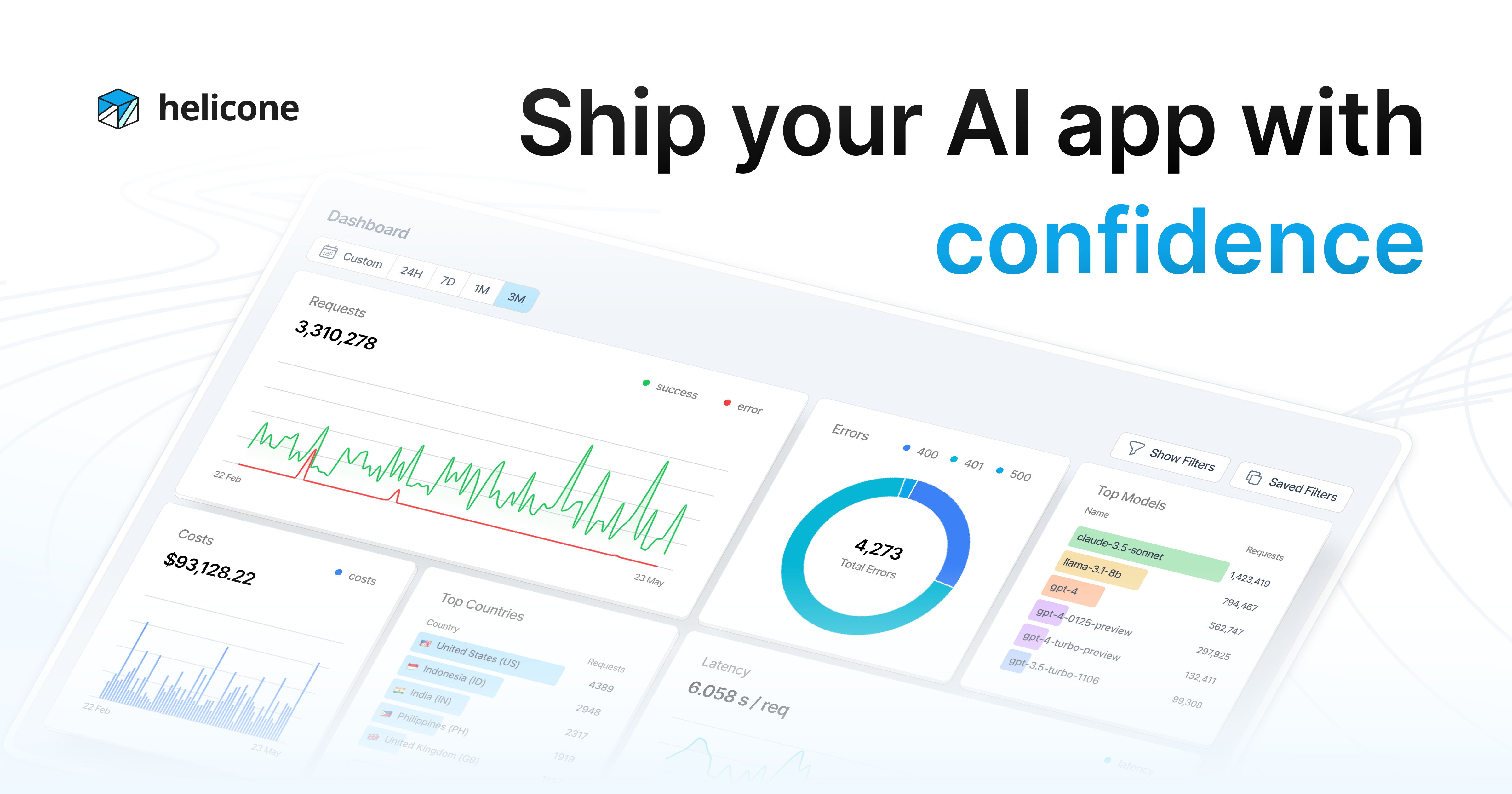
Helicone approached prompt management from the observability side. The proxy-based integration drops between your app and the LLM provider, capturing every request with cost, latency, and prompt content. Prompt versioning shipped as a later feature and benefits from being grounded in production traces from day one. Generous free tier.
Where it falls short: Proxy adds a hop in the request path — latency is small but measurable. Evaluation pipelines are functional but less mature than PromptLayer’s. Some advanced features require enterprise tier.
Pricing:
- Free: 100,000 requests/month
- Paid: $20/mo Pro, $50/mo Team, custom Enterprise
- Platforms: Web app, self-hosted option, proxy or async logging
Download: Helicone
Bottom line: Pick this when production observability is the start of the workflow and prompt management is the natural next step.
5. Latitude — Best domain-expert collaboration
Latitude is positioned for collaboration between domain experts (legal, medical, finance) and engineers. The UI is built for non-technical reviewers, and the platform handles the engineering plumbing automatically. Open-source community edition exists alongside the hosted enterprise tier.
Where it falls short: Smaller ecosystem than PromptLayer or LangSmith. Documentation lags the feature set in places. Hosted pricing is enterprise-focused.
Pricing:
- Free: open-source community edition, self-hosted
- Paid: custom Enterprise for hosted version
- Platforms: Web app, Docker self-host
Download: Latitude
Bottom line: Pick this when the team includes both engineers and non-technical reviewers and you want a UI built for both.
6. Agenta — Best open-source platform
Agenta is the open-source prompt engineering platform that ships a substantial feature set without a paid tier. Versioning, evaluation, deployment management, and observability — all self-hostable under MIT-style licensing. The 2026 release improved the evaluation framework significantly.
Where it falls short: Self-host operational cost falls on you. UI is utility-first rather than polished. Smaller community than the commercial leaders.
Pricing:
- Free: full feature set, self-hosted
- Paid: optional managed cloud tier
- Platforms: Docker, Kubernetes, runs on any desktop with Docker installed
Download: Agenta
Bottom line: Pick this when you want a full platform without a SaaS bill and have infra capability in-house.
7. Pezzo — Best Apache-licensed option
Pezzo sits in the same self-hosted space as Agenta with a different license (Apache 2.0) and a developer-first architecture. PostgreSQL, ClickHouse, Redis, and Supertokens under the hood — choose the components you trust. Active development through 2026 and a clean codebase make it a popular pick for teams who plan to modify the platform.
Where it falls short: Operational complexity is real — the multi-component stack takes more setup than Agenta or LibreChat. Smaller user community than the SaaS tools. Some features still rough around the edges.
Pricing:
- Free: open source under Apache 2.0
- Paid: none
- Platforms: Docker Compose stack, runs on any desktop or server
Download: Pezzo on GitHub
Bottom line: Pick this when license matters (Apache 2.0 vs. less permissive options) and self-hosting is the model.
8. Promptfoo — Best CLI-first testing tool
Promptfoo is a CLI tool for prompt evaluation and testing. Drop a promptfooconfig.yaml in your repo, list the prompts to test, the test cases to run, and the metrics to grade against. It integrates with CI/CD pipelines as a standard unit-test-style step. The web UI exists but the value is the command-line flow.
Where it falls short: Not a full prompt management platform — there is no central library or web-based editing. Built for testing rather than versioning. Better as a complement to one of the platforms above than a replacement.
Pricing:
- Free: open source under MIT
- Paid: enterprise add-ons for hosted and team features
- Platforms: macOS, Windows, Linux CLI; install via npm or Homebrew
Download: Promptfoo
Bottom line: Pick this as the CI-integrated test harness alongside whichever platform you use for the prompt library.
How to pick the right one
If you want the simplest option: PromptHub at $12/mo is the lowest-friction entry to versioned prompt management for solo developers and small teams.
If you need release labels and evaluation pipelines: PromptLayer is the only tool that handles both at depth, and the workflow scales to large teams.
If you live in LangChain: LangSmith is the same studio’s matching tool — the integration friction is one import line.
If you want observability first: Helicone captures production traces from day one and lets prompt versioning emerge from real usage.
If your team includes non-technical reviewers: Latitude is built for that workflow specifically.
If self-hosting is the requirement: Agenta for the most polished open-source experience, Pezzo for Apache 2.0 licensing.
If you want CI-integrated prompt testing: Promptfoo beside any of the above as the test harness.
If you tried PromptLayer and found it too heavy: PromptHub gives you 80% of the versioning workflow at a fraction of the price.
FAQ
What is the best free AI prompt management app?
Agenta and Pezzo are both free, fully featured, and open-source. Among SaaS options, Helicone has the most usable free tier with 100,000 requests/month.
Do I need a prompt management tool at all?
If your AI feature is a one-shot prompt that rarely changes, no — a .txt file in your repo is fine. If you ship prompt changes weekly, run A/B tests, or compare model output across providers, yes.
Can I version-control prompts with Git instead?
Yes, and many teams start that way. The prompt management tools add value when you need to change prompts without redeploying code, evaluate across datasets, or trace production behaviour back to specific prompt versions.
Which tool works best for a solo developer?
PromptHub at $12/mo for the SaaS path, Promptfoo for the CLI-first path, Agenta if you want a self-hosted platform with no operating cost beyond the box you run it on.
Are these tools model-agnostic?
Most are. PromptLayer, PromptHub, Helicone, Agenta, Pezzo, and Promptfoo support OpenAI, Anthropic, Google, and self-hosted models out of the box. LangSmith is LangChain-bound but supports the same providers through LangChain abstractions.